Summary:
Almost every generator conversation we have in Abilene, San Angelo, Midland, and Lubbock starts with the same question, and it usually comes before anyone has said the word “kilowatt”: what is this going to cost me? It is a fair question and a frustrating one to research, because the numbers online swing from $2,000 to $30,000 with very little explanation of why.
The spread is real, and it is not random. A whole-house generator is not a product you buy. It is a product plus an installation, and the installation is where West Texas homes diverge from the national averages. This guide gives you the actual ranges, breaks the installed price into line items you can check against any quote, and shows which factors on your property move the number most.
How Much Does a Whole-House Generator Cost in West Texas?
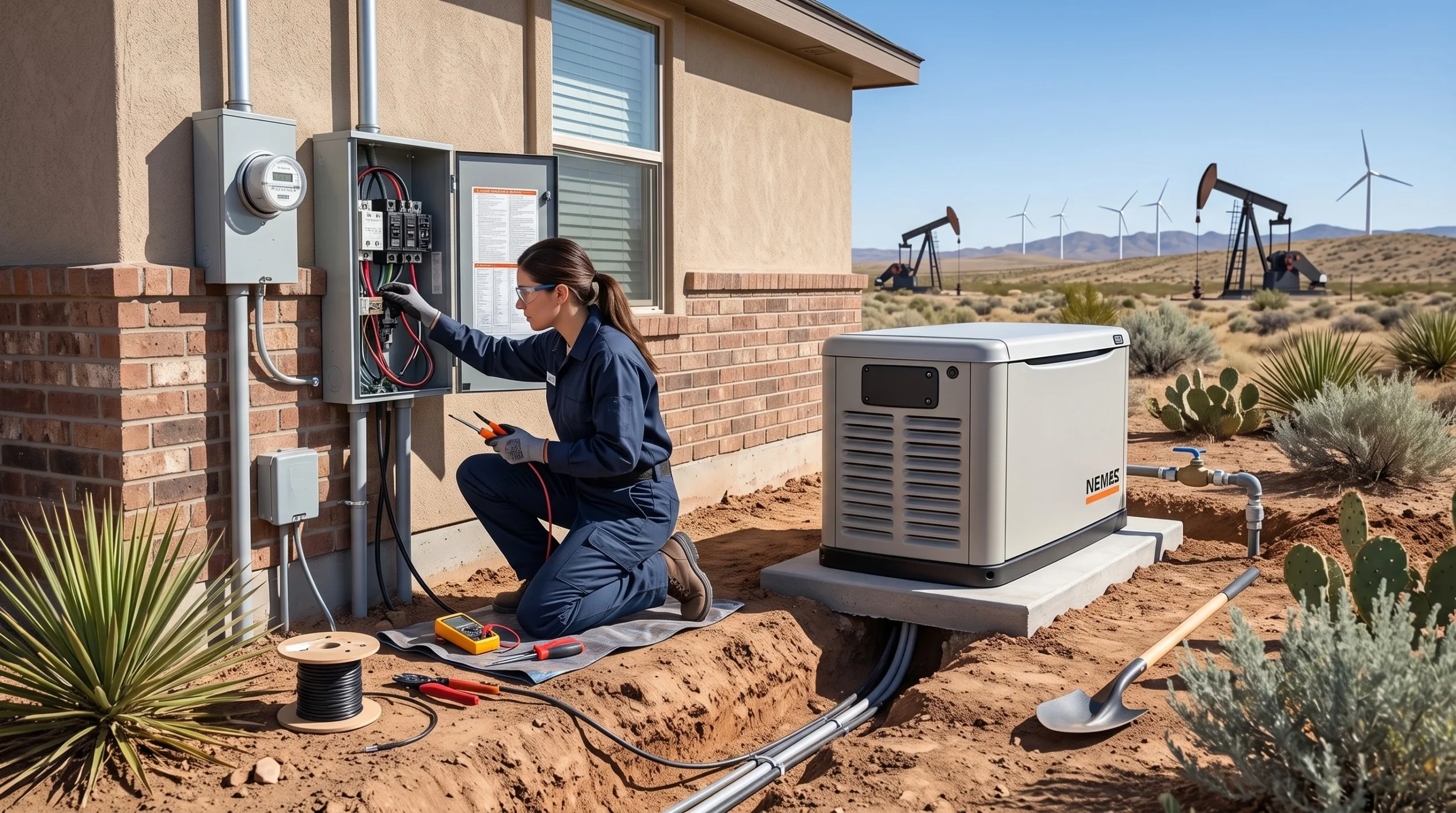
For a typical single-family home in West Texas, expect $9,000 to $15,000 installed for a whole-house standby generator in 2026. The 22kW air-cooled Generac Guardian (the most commonly installed residential standby unit in the country) runs roughly $11,000 to $14,000 turnkey when it connects to an existing natural gas line.
Smaller essential-loads systems come in lower. A 10kW to 14kW unit covering a refrigerator, lights, the furnace blower, a well pump, and a few circuits can be done for $7,000 to $10,000 installed. At the other end, a liquid-cooled 25kW-plus system for a large all-electric home or a property with shops and outbuildings can run $18,000 to $25,000 or more.
Getting that number right starts with knowing your loads. If you are unsure, our guide on how to size a backup generator for your home walks through the calculation. Portable generators are a different category: $500 to $2,500 for the unit, plus $800 to $2,500 for a manual transfer switch and inlet installed by a licensed electrician. They cover a handful of circuits and need you home to start and refuel them, not a whole-house solution, but a legitimate budget option worth understanding before you rule it out.
What You're Actually Paying For: The Installed Cost, Line by Line
Here is where the money goes on a typical 22kW natural-gas standby installation. Use it as a checklist against any quote you receive: a contractor who will not itemize these is worth questioning.
| Line item | Typical 2026 range | What moves it |
|---|---|---|
| Generator unit (air-cooled 18 to 24kW) | $3,500 to $8,000 | Brand, kW rating, warranty, air- vs liquid-cooled |
| Automatic transfer switch | $500 to $1,500 | Whole-home vs load-managed; amperage |
| Electrical labor & wiring | $1,500 to $3,000 | Distance panel to pad; conduit; trenching |
| Gas line connection | $500 to $1,500 | Length of run; meter upgrade; NG vs propane |
| Concrete pad / base | $300 to $800 | Pad size; grading; caliche and rocky soil |
| Permits & inspection | $200 to $500 | Varies by city (Abilene, San Angelo, Midland, Lubbock) |
| General labor / set | $1,000 to $2,000 | Site access; unit weight |
| Panel upgrade (if needed) | $1,800 to $4,000 | Older 100-amp panels often need upgrading first |
| Propane tank (if no NG) | $1,500 to $3,500 | Buried vs above-ground; 250 vs 500 gallon |
Add it up and the pattern is clear: the generator is only about 40 to 55% of the installed price. Everything else is the work of tying it into your home safely and legally, which is exactly why an over-the-phone quote is worth so little.
Generac Whole-House Generator Cost: What the Brand Premium Buys
Generac holds the largest share of the residential standby market, and its Guardian series is what most West Texas homeowners compare against. A 22kW Guardian unit alone typically runs $5,000 to $6,500; installed, $11,000 to $14,000. Kohler and Briggs & Stratton units sit in a similar band, sometimes $500 to $1,500 higher for comparable output.
What the brand premium actually buys is parts availability and service-network depth, which matters more than spec sheets when your unit needs a control board in year seven. Before you choose, ask your electrician which brands they are a certified dealer for; a certified installer means warranty work gets handled locally instead of shipped.
Why West Texas Generator Installs Land Where They Do on the Price
National cost guides assume a suburban home on a municipal natural gas line with a modern 200-amp panel and a flat, accessible side yard. Plenty of homes across Taylor, Tom Green, Midland, and Lubbock counties do not match that description, and each difference carries a price.
The biggest one is fuel. Outside city limits, natural gas service often is not available, which means propane. A buried 500-gallon tank sized to run a standby generator through a multi-day outage adds $1,500 to $3,500 to the project, plus ongoing fuel costs, and propane delivers slightly less power per unit than natural gas, so the sizing shifts with it. This single factor is the most common reason a rural quote comes in $2,000 to $4,000 above an in-town one.
There is also the grid math. Texas runs its own grid with limited ability to import power from neighboring states, and Winter Storm Uri showed what that means at the extreme. Day to day, the number that matters more for rural homeowners is restoration time: properties on rural electric cooperatives routinely wait 24 to 48 hours or longer after a major storm, because crews cover enormous service areas and reach dense areas first. That is not a knock on the co-ops. It is arithmetic, and it is why backup power is valued differently out here than in a city where the lights return in three hours.
Well Pumps, Outbuildings, and the Rural Premium
If you are on a private well, the pump is not optional: without power there is no water. A half-horsepower submersible pump draws around 1,000 running watts but can surge past 2,000 on start, and a one-horsepower pump pushes higher still. Shops, barns, livestock water systems, and ventilation equipment add their own loads. Every one of those pushes you toward a larger unit, and unit size is the single biggest line item on the quote.
The takeaway: a rural property is rarely a “smallest unit” job. Budgeting from an in-town neighbor’s quote will almost always come up short, because their gas line and their load list are not yours.
Older Panels, Service Upgrades, and Ongoing Costs
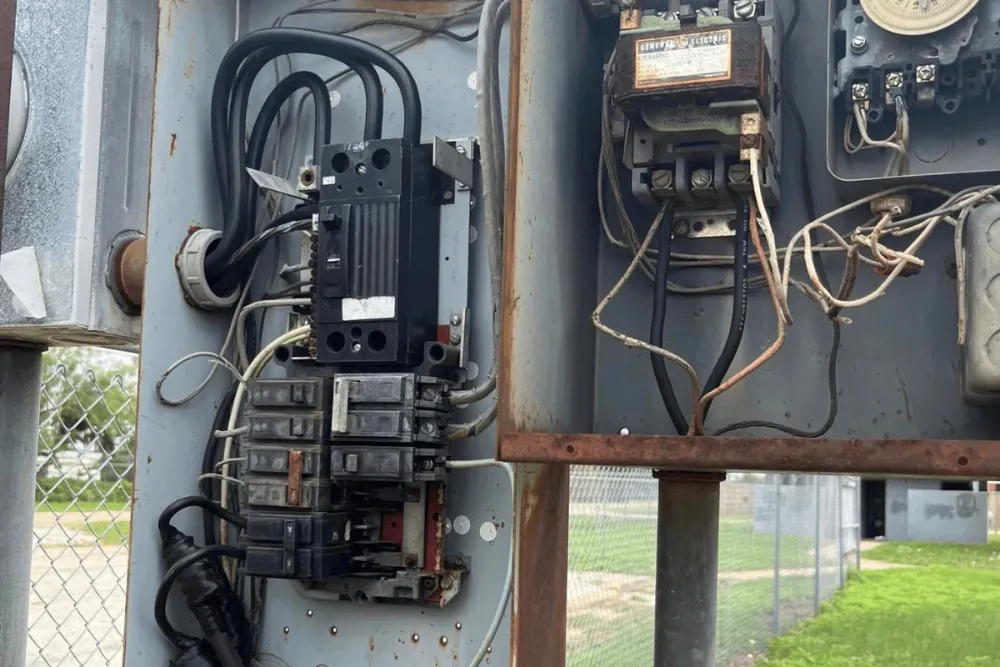
Plenty of homes in older Abilene and San Angelo neighborhoods still run 100-amp service. A whole-home standby system usually needs a 200-amp service and a panel that can accept the transfer switch. If yours cannot, budget $1,800 to $4,000 for a panel upgrade before the generator work begins. This is the most common surprise in a generator project, and exactly what an on-site evaluation catches and an online calculator does not.
The install is the big number, but it is not the last one. Annual maintenance (oil, filters, plugs, battery, and a load test) runs $200 to $400 a year, and skipping it is the most common reason a generator fails on the one night it was bought for. Batteries need replacing every three to five years at $100 to $200. Factor in $250 to $500 a year all-in, and plan on a 15- to 20-year service life for a properly sized, maintained unit.
Whole-House Generator Cost: Frequently Asked Questions
How much does a whole-house generator cost installed?
In West Texas in 2026, expect $9,000 to $15,000 installed for a typical single-family home. The most common configuration (a 22kW air-cooled unit on an existing natural gas line) runs about $11,000 to $14,000 turnkey. Smaller essential-loads systems start near $7,000; large liquid-cooled systems can exceed $20,000.
Why is installation more than half the cost of a whole-house generator?
Because a standby generator has to be tied into both your electrical service and a fuel supply. The transfer switch, wiring, gas line run, concrete pad, permitting, and inspection are all separate scopes of work. On a $12,000 project the unit is usually $5,000 to $6,500 and the rest is installation.
What size whole-house generator do I need, and how does that change the price?
Most West Texas homes land between 10kW and 22kW, depending on whether central air and a well pump are included. Essential loads only often fit in 5kW to 7kW. Every step up in kilowatts raises the unit cost, so sizing correctly is the biggest cost lever you control.
Does a propane generator cost more than natural gas?
Yes, mainly because of the tank. If natural gas is not available, a buried propane tank adds $1,500 to $3,500 up front plus ongoing fuel, and propane produces slightly less output than natural gas for the same unit.
Will I need a panel upgrade before installing a generator?
Possibly. Homes on 100-amp service usually need an upgrade to 200-amp first, adding roughly $1,800 to $4,000. An on-site panel evaluation determines this. It cannot be answered over the phone.
Are online whole-house generator cost calculators accurate?
They are useful for a ballpark and unreliable for a budget. Calculators cannot see your panel age, fuel source, gas meter distance, well pump horsepower, or site access: the exact variables that create the spread between the low and high end.
Ranges are useful for planning, but they are not a quote. If you want to know what a standby generator costs at your address (with your panel, your fuel source, and your loads), the next step is an on-site load calculation. Hooked Up Electric installs whole-home standby systems across West Texas from offices in Abilene, San Angelo, Midland, and Lubbock. Our licensed electricians run the load calculation on site, pull all permits, handle inspection, and give you an itemized price before any work starts. Call 325-442-5594 to schedule your free estimate.
Ready for a real quote? We install standby generators across West Texas: see generator installation in Abilene, San Angelo, Midland and Lubbock, or request a free quote and we will size the unit for your home.