Summary:
Warning Sign 1: Flickering or Dimming Lights Throughout Your Home
Flickering, buzzing, or dimming lights are symptoms of outdated or damaged wiring, especially when lights buzz when turned on or flicker when you use multiple appliances. This isn’t just about a loose bulb that needs tightening.
When lights dim or flicker consistently, particularly when you turn on major appliances like your air conditioner or washing machine, your electrical system is struggling to handle the load. Flickering lights can be a warning sign of fire hazard, especially when they occur throughout the house and aren’t associated with large appliances turning on.
When Flickering Lights Signal Serious Problems
Not every light flicker means you need to panic, but certain patterns should get your immediate attention. You need to pay attention if your lights flicker randomly or turn off and on intermittently. This type of erratic behavior often indicates loose connections or deteriorating wiring that could spark an electrical fire.
Old or loose wiring is a significant concern for homeowners, as faulty wiring is a leading source of house fires that could be avoided when paying attention to lighting services. The problem becomes more serious when multiple lights throughout your home flicker simultaneously, suggesting an issue with your main electrical panel or service entrance.
Professional electricians can distinguish between simple fixes like loose bulbs and serious wiring problems that require immediate attention. When wiring is loose or aged, electric currents jump these gaps in a process called arcing, with each jump carrying a charge at temperatures over thousands of degrees Fahrenheit, making arcing a deadly reality for thousands of homes that catch fire each year.
What Your Lights Are Telling You About Your Electrical System
Your lighting system provides valuable clues about your home’s overall electrical health. Overloaded circuits are a common cause of lights flickering, happening when too many appliances or light fixtures run simultaneously on the same circuit. This is particularly common in older homes where the electrical system wasn’t designed for today’s power demands.
Most homes operate on standard 120-volt circuits, and your electrical voltage should stay between 115 and 125 volts: readings above 125 volts may indicate serious electrical system faults, with signs including light bulbs burning out faster than normal or lights dimming inconsistently. These voltage fluctuations can damage your appliances and create fire hazards.
In Taylor County, TX, many homes built in previous decades weren’t designed to handle modern electrical loads. Smart TVs, computers, kitchen appliances, and HVAC systems all demand more power than homes originally provided. When your electrical system can’t keep up, lights are often the first place you’ll notice problems. Professional electrical inspection can identify whether your system needs upgrades to safely handle your current power needs.
Warning Sign 2: Circuit Breakers That Trip Frequently
Frequent circuit breaker trips and flickering lights are signs of faulty electrical wiring. Your circuit breaker is designed to protect your home by cutting power when circuits become overloaded, but when breakers trip repeatedly, it signals underlying problems that need professional attention.
Electrical overload is the most common reason for circuit breakers to trip, happening when too much electrical load is on a specific circuit or when you have too many energy users on at once. However, frequent tripping often indicates more serious issues than simple overloading.
Understanding Why Your Breakers Keep Tripping
Short circuits occur when hot or active electrical wires touch neutral wires, causing large amounts of current to flow and overload the circuit, which should always cause breakers to trip and might cause sparks, popping sounds, and possibly smoke. These situations create immediate fire hazards that require professional intervention.
Older homes with electrical wiring that hasn’t been updated to meet modern appliance needs could lead to more frequent circuit breaker trips, and homeowners could benefit from having licensed electricians inspect wiring to see if it’s up to code and needs updating. This is especially relevant in Taylor County, where many homes were built before today’s electrical demands existed.
Overloaded or damaged wiring can cause overheating, which may ignite surrounding materials and start fires: a significant risk in older homes with outdated wiring systems, particularly when too many devices draw power from single circuits. Ground faults present another serious concern, especially in areas with water exposure like kitchens and bathrooms.
The Hidden Dangers of Ignoring Frequent Breaker Trips
Many homeowners treat frequent breaker trips as minor inconveniences, simply resetting the breaker and continuing with their day. This approach ignores potentially dangerous underlying problems that worsen over time. Repeated power interruptions can damage sensitive electronics like computers and televisions, with delicate components adversely affected by power surges and drops, while constant tripping and resetting can wear out appliance components, leading to shorter lifespans and increased maintenance costs.
More importantly, frequent breaker trips often indicate serious safety hazards developing in your electrical system. Outdated electrical systems pose various safety issues including overloaded circuits and frequent breaker trips that can lead to fires, with modern appliances often straining old wiring since it wasn’t built to handle this type of equipment.
Professional electrical inspection can identify whether your frequent breaker trips result from simple circuit overloading or more serious problems like deteriorating wiring, faulty connections, or inadequate electrical panels. Many homes, especially older ones, have electrical service panels not equipped to handle modern electrical loads, and with increasing numbers of electrical devices in today’s homes, outdated service panels can lead to frequent breaker trips and potential safety hazards. Upgrading your electrical system not only eliminates the frustration of frequent outages but also ensures your family’s safety.
Warning Sign 3: Outlets and Switches That Feel Warm, Look Discolored or Buzz
An outlet should be unremarkable. It should feel the same temperature as the wall around it, look the same color it did the day it was installed, and make no sound at all. When any of those three things changes, the fault is almost always behind the faceplate, where you cannot see it.
Warmth is the clearest signal. A faceplate that is warm to the touch means there is resistance somewhere in the connection, and resistance means heat building up inside a wall cavity surrounded by insulation, framing and drywall. A plug that feels hot when you pull it out points the same way. Some warmth is normal on a device drawing heavy current, such as a space heater or a window unit, but the outlet itself should never be the hot part.
Discoloration is warmth that has already been happening for a while. Yellow or brown staining around the slots, a faceplate that has gone beige next to its neighbors, or a plug with darkened prongs all point to a connection that has been arcing intermittently. Once you can see the mark, the damage is done and the device needs replacing, not resetting.
Buzzing, crackling or a faint sizzling sound from a switch or outlet is the one to treat as urgent. That noise is an arc, electricity jumping a gap it should not be crossing, and arcs are what start fires inside walls. Stop using the outlet, switch off the breaker feeding it, and have it looked at before you use it again.
Loose plugs belong in the same group. If a plug slides out of an outlet under its own weight, the internal contacts have lost their grip. The connection is intermittent, and intermittent connections arc. Outlets are inexpensive to replace. The wiring damage they cause when they are ignored is not. Replacing failing outlets and switches is a routine call for our electrical installation team.
Warning Sign 4: A Burning Smell or Scorch Marks You Cannot Explain
A burning smell with no obvious source is the one warning sign on this list that should stop what you are doing. Everything else here is a reason to book an appointment. This is a reason to switch off the affected circuit at the panel and call someone today.
Electrical burning has a particular character: sharp and acrid, closer to hot plastic than to woodsmoke. It comes from insulation overheating around a conductor. What makes it dangerous is that the smell reaches you long before there is anything to see, because the heat is inside a wall, a ceiling void or the back of the panel.
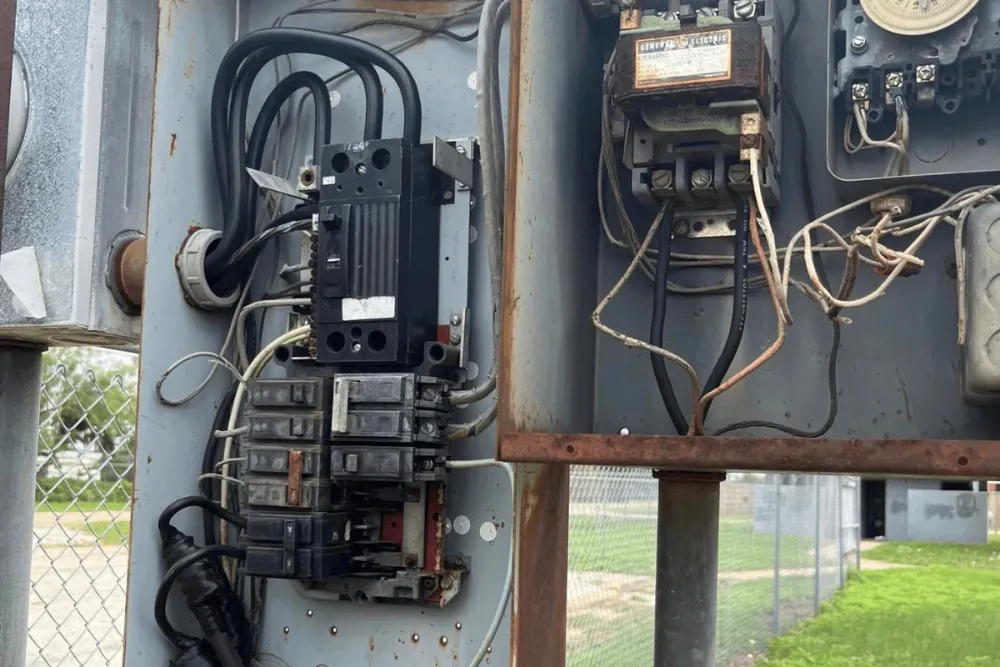
Scorch marks are the visible version of the same problem: a dark halo around an outlet, a smudge above a light fixture, a brown patch on the panel cover. If you check nothing else, stand in front of your breaker panel. Rust streaks, a burnt smell near it, or discoloration around any breaker means the panel itself is in trouble.
What to do, in order: switch off the breaker for the affected area; if you cannot identify which breaker it is, switch off the main; do not put water on anything electrical; and get a licensed electrician out the same day. If there is visible smoke or flame, leave the house and call 911 first.
Homeowners often talk themselves out of this one because the smell fades. It fades because the load came off the circuit, not because the fault repaired itself. It will be back the next time the same appliance runs.
Warning Sign 5: An Aging Panel, Two-Prong Outlets, or Aluminum Branch Wiring
The first four signs are things your electrical system is actively doing. The fifth is about what it is: the age and type of the equipment behind the wall, which can be a problem long before it produces a symptom. Four things put a home in this category.
- A 100 amp service or smaller, or a fuse box instead of breakers. A house wired for 60 amps was wired for a refrigerator, some lights and a television. It was not wired for a heat pump, a hot tub, an induction range and an EV charger. Undersized services rarely fail dramatically. They run hot and trip often, which is how signs one and two usually begin.
- Two-prong outlets. No third slot means no ground. Anything with a metal case plugged into an ungrounded outlet has no safe path for a fault current except through the person holding it. Solving it with a three-prong adapter makes the situation worse rather than better, because it hides the problem behind a plug that now fits.
- A Federal Pacific (Stab-Lok) or Zinsco panel. Both brands are widely flagged by home inspectors and electricians for breakers that do not always trip under fault. Neither was formally recalled, so this is a judgment call rather than a rule, but if the label inside your panel door reads Federal Pacific or Zinsco it is worth having someone competent evaluate it.
- Aluminum branch wiring. Common in homes wired between the mid 1960s and the early 1970s. Aluminum expands, contracts and oxidizes differently from copper, so terminations loosen over time. It can be made safe, but it takes the right connectors, correctly installed.
None of these will announce themselves. They sit quietly until load or age catches up with them, which is exactly why age on its own is a legitimate reason to book an inspection. If the panel is the issue, our circuit breaker and panel upgrade service covers both the assessment and the replacement.
Frequently Asked Questions About Electrical Inspections
How often should a home have an electrical inspection?
Every five to ten years for a home in good condition, and sooner if any of the five signs above appear. A home over 25 years old, a home you have just bought, and a home you have just added a major appliance or an EV charger to are all worth inspecting regardless of the calendar.
How long does a home electrical inspection take?
For a typical single-family home, most of a morning. One to three hours is normal, depending on the size of the house, how accessible the panel is, and how much of the wiring can actually be reached. Larger homes, homes with sub-panels, and homes with a detached shop or added circuits take longer.
What does an electrical inspection actually cover?
The service and the panel, breaker sizing against the conductors they protect, grounding and bonding, GFCI and AFCI protection where it is required, the condition of outlets, switches and fixtures, accessible wiring and junctions, and any sign of overheating or of previous unpermitted work. You should come away with a written summary of what was found and what needs attention first.
How much does an electrical inspection cost in West Texas?
It depends on the size and age of the home and how much of the system can be reached. We have published a fuller breakdown of what electrical work costs in West Texas, and we quote an inspection before the work starts rather than after.
Do I need an electrical inspection before buying or selling a house?
Texas does not require one. It is worth understanding, though, that a general home inspection is not an electrical inspection. A home inspector reports what is visible and defers anything technical. If a buyer’s report raises the panel, aluminum wiring, or an addition that may not have been permitted, a licensed electrician’s assessment is what settles it.
Can I check any of this myself?
You can do the safe half. Look for warmth, discoloration, scorch marks and loose plugs. Count how often breakers trip and which ones. Press the test and reset buttons on your GFCI outlets. Read the brand and the amperage on the panel label. Do not remove the panel cover, and do not attempt repairs on a circuit that has already shown one of the signs above. The main lugs inside a panel stay live even when the main breaker is switched off.
Don’t Wait for Warning Signs to Become Emergencies
The recommended frequency for electrical inspections in residential settings is every 5 to 10 years, depending on factors such as home age, quality of previous electrical work, and noticeable changes in electrical system performance. However, when warning signs appear, waiting for your next scheduled inspection isn’t worth the risk.
Older houses require more care, and if your house is more than 25 years old, it’s absolutely due for a check-up. Professional electrical inspection provides peace of mind and can prevent minor issues from becoming major safety hazards or expensive repairs.
We provide Taylor County homeowners with thorough electrical inspections that go beyond basic requirements. Our licensed electricians understand the unique challenges facing older homes in our area and provide clear, honest assessments of your electrical system’s condition and safety.
If you have spotted any of these five signs in your home, book an inspection rather than waiting to see whether it gets worse. We cover Abilene, San Angelo, Midland and Lubbock, and we will tell you plainly what needs doing now and what can safely wait.
For a closer look at the difference between normal warmth and a real problem, see this guide to warm plugs and outlets.